System Debugging: Manage Your Mind Like a Developer
Transform mental chaos into manageable architecture through voice-thinking methodology
System Debugging: Manage Your Mind Like a Developer
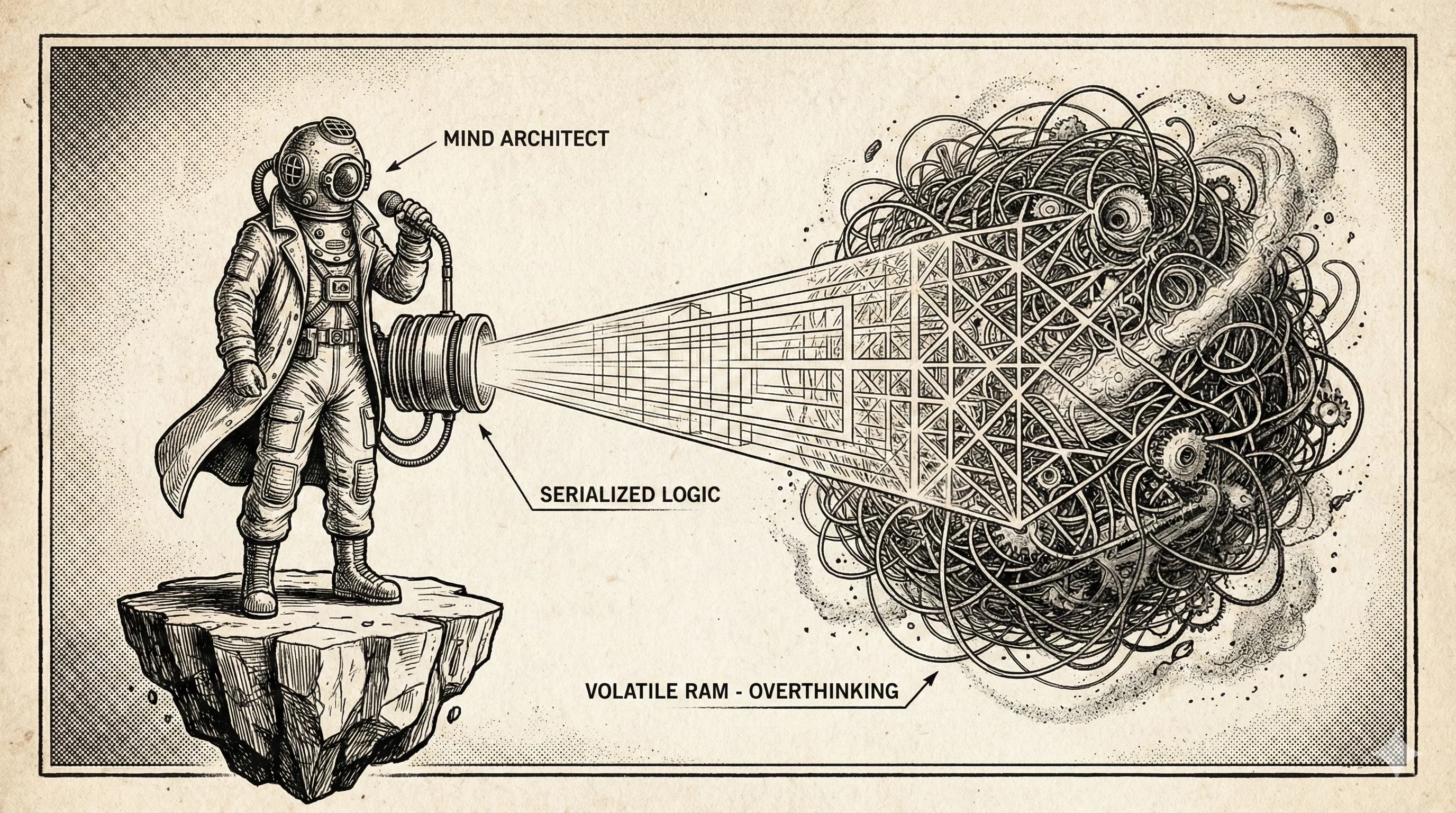
The operating system in your mind is on the verge of crashing, overwhelmed by hundreds of background processes running without your awareness. The greatest tragedy of modern humans isn't insufficient processor capacity (IQ)—it's the failure to manage RAM (Working Memory).
You think you've captured an idea, but within seconds, a notification, a car horn, or an irrelevant memory intrudes, and that idea evaporates like data in a RAM module when the power is cut. Thoughts, by their nature, are volatile. Unless you commit them to a physical form, they're nothing but electrical noise between your neurons.
Most people mistake this noise for "thinking." But it's just mental rumination. True thinking is the process of producing output.
The biggest obstacle we face here is the massive mismatch between thought speed and recording speed. While the human mind can generate images and concepts equivalent to thousands of words per minute, even the fastest typist among us can only write 40-50 words per minute.
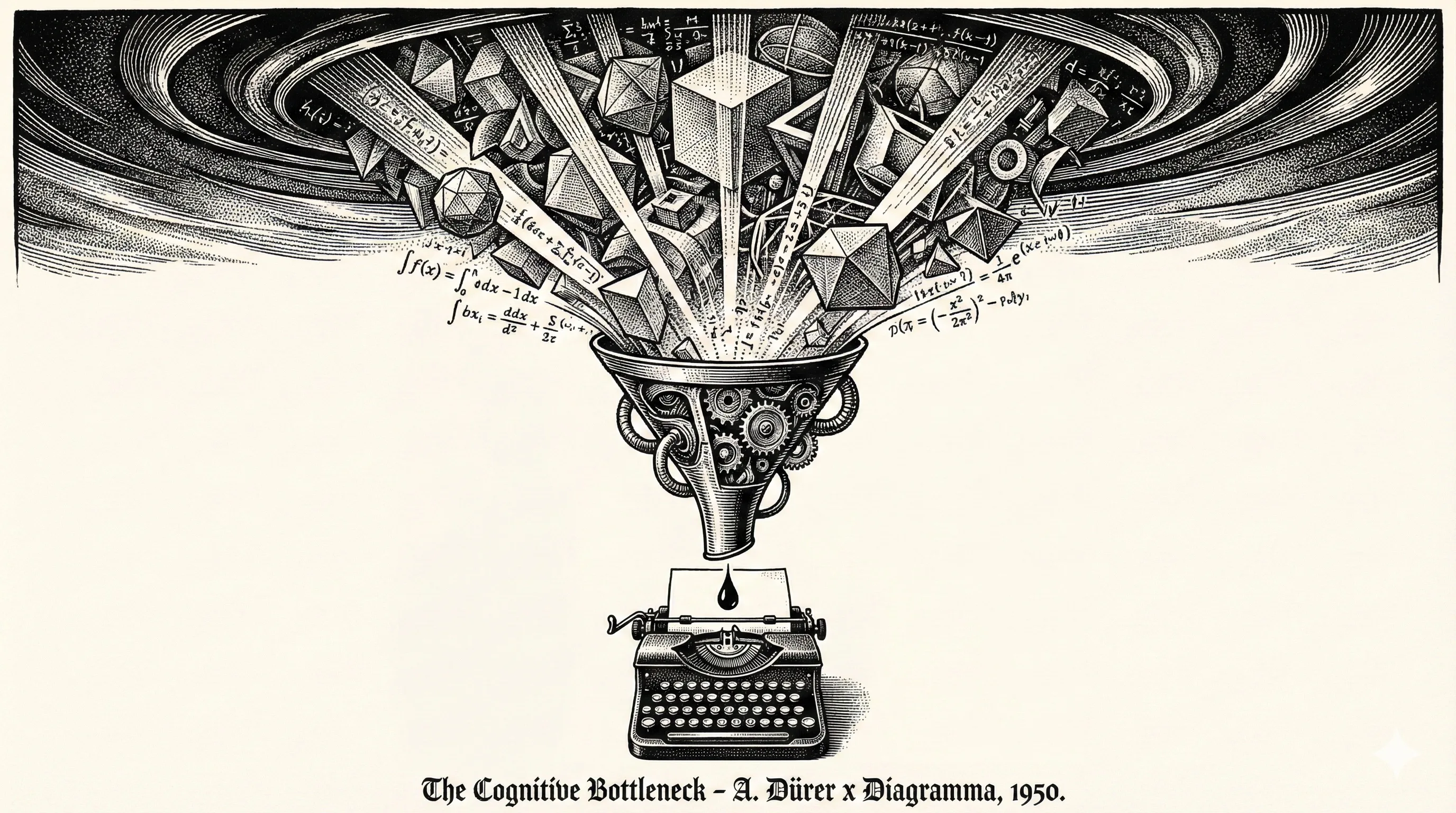
This "bottleneck" causes most data to be lost or oversimplified. This is where the "System Debugging" methodology comes in. We must adapt the "Debugging" principle that developers use to find bugs in complex code blocks to cognitive processes, transforming chaos into manageable architecture.
And the most powerful tool for this process isn't a keyboard—it's your own voice.
Reality Approach Protocol: Why Should We Think Out Loud?
Voicing thoughts isn't a crazy act of talking to yourself—it's a strategic "Serialization" process.
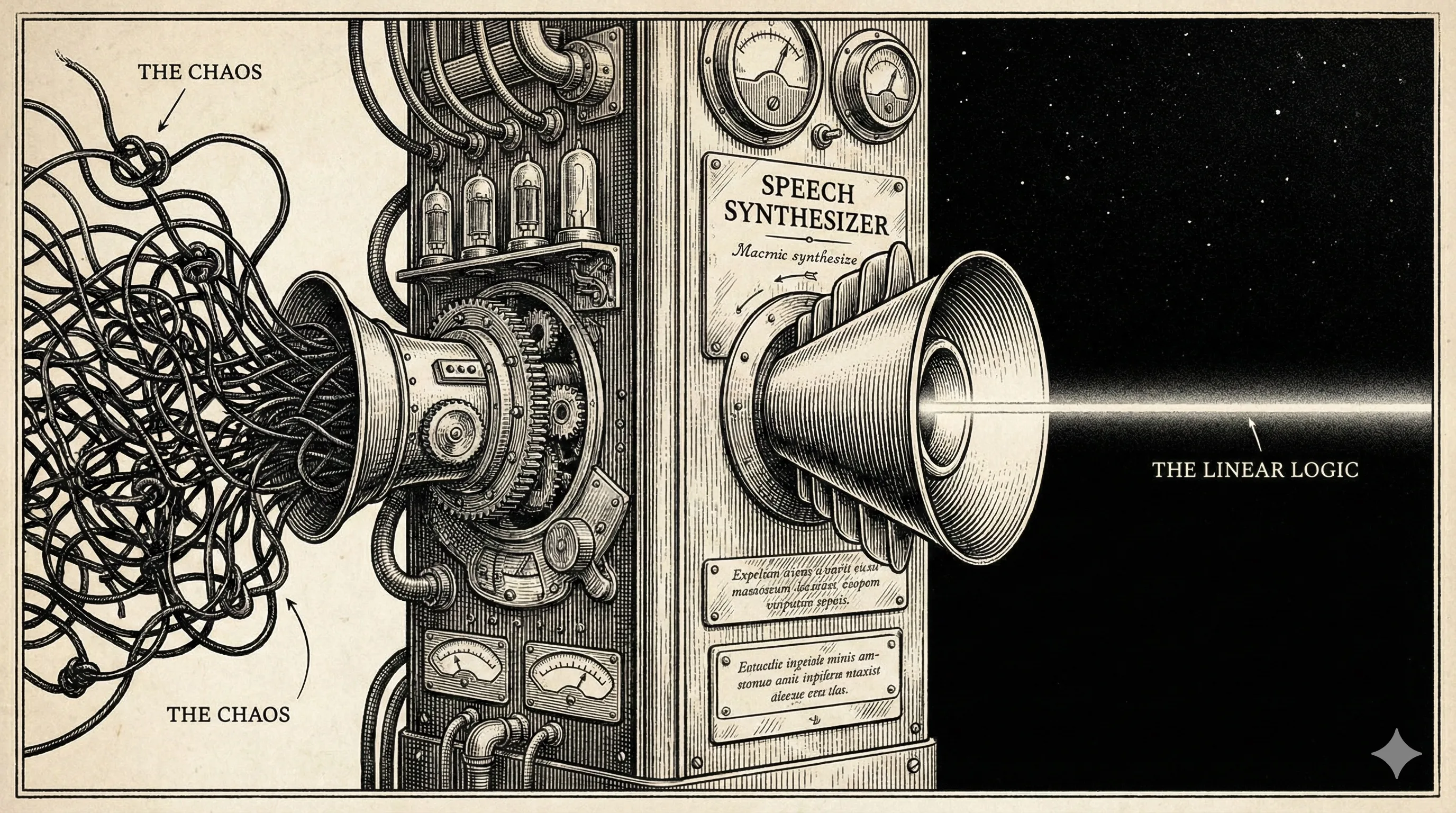
In your mind, thoughts exist in a tangled ball, non-linear, three-dimensional, and chaotic. You can simultaneously think about dinner, a bug in your project, and an existential crisis. However, speaking is biologically forced to be linear. Two words cannot come out of your mouth at the same time.

When you force yourself to express a thought out loud, you force your mind to turn that complex tangle into a single thread—into a linear logical sequence.
Voice makes thought vibrate in the physical world.
When an idea is only in your head, it's easy to ignore logical gaps. Your mind can deceive you with "this is a great idea." But the moment you say it out loud, the instant you hear it with your own ear (auditory feedback loop), you immediately notice the nonsense and logic errors.
Voice is the first "Unit Test" of thought. Your own voice becomes your harshest critic. Sound waves vibrating in the air transport thought from the abstract world to concrete reality, turning it into an "Artifact."
Methodology: The System Debugging Cycle
System Debugging isn't random talking. It's an iterative, three-phase process following a specific protocol. This process aims to transform raw data (chaotic thoughts) into a refined strategy (clear actions).
Phase 1: The Raw Dump
The first step is to completely empty mental RAM.
Open your phone's voice recording app and start walking. Whatever the topic, speak everything in your mind without applying any filters, without grammar concerns. This phase is not a brainstorm—it's a "Brain Purge" session.
Just like a developer using Console.log to print all variables to the screen, you must export all data from your mind:
- "I'm worried right now because..."
- "This project isn't working because..."
- "Maybe I should do it this way..."
The goal is to empty the mind and relieve the processor, rather than quality. This recording typically takes 10 to 15 minutes, and when you finish, you'll feel a physical weight lifted from your shoulders. Because the data is no longer in RAM—it's on disk (the recording file).
Phase 2: Transcription and First Confrontation (Decode)
After finishing the recording, transcribe this audio to text, preferably using an AI tool or manually.
Reading your own thoughts as if they belonged to someone else gives you an incredible "Meta-perspective." While reading, you'll notice: some of your sentences are brilliant, others are pure noise.
Working on the text, mark the main themes, recurring fears, and hidden brilliant ideas. This is the phase where raw data transforms into information. You begin to see the patterns within the chaos.
Going Deeper: Refinement of Refinement (Iterative Refinement)
This is the heart of the System Debugging methodology and where the "Eureka Moment" occurs. Most people complete the first two steps and stop. But the real magic happens in the third step: Refinement of Refinement.
You've read the transcript of your first recording, taken notes, and built a structure. Now, you must take these notes and start a second voice recording.
This time, you're not the scattered, fearful, and indecisive person from the first recording. Now you're a strategist with data, who knows what they're talking about. In the second recording, synthesize the raw thoughts from the first recording and explain the subject to yourself (or an imaginary listener) clearly, concisely, and in a structured manner.
Here's what happens in this process:
The first recording has cleaned out the emotional load and unnecessary details (bloatware). The second recording is entirely focused on solutions and action. This cycle where you take your own thought, process it, and sell it back to yourself crystallizes your beliefs.
The difference between merely thinking a thought and voicing it, analyzing it, restructuring it and voicing it again is like the difference between candlelight and a laser beam. One merely illuminates; the other cuts and shapes.
This second recording is your "Action Plan." There's no more uncertainty. Because uncertainty hides in the shadow of undefined thoughts. And you have defined everything, named it, and sealed it with your voice.
Refinement of refinement elevates thought to the level of "belief." And people only take action for things they believe in.
Conclusion: Exiting the Simulation

Overthinking is a simulation error of the mind. The mind tries to keep you safe by continuously running potential future scenarios, but it enters a loop and paralyzes you (Analysis Paralysis). System Debugging is the "Render" button that stops this simulation.
You should be disturbed by the noise in your mind. That noise is unprocessed data. And unprocessed data is burden.
Starting today, when you face a complex problem or your mind becomes cloudy, don't stop to think. Walk and talk. Use your voice. Take your thoughts out of the dark corridors of your mind and expose them to the light of sound waves.
You'll see that most of your fears will vanish in daylight, while your ideas will transform into bulletproof projects.
Remember: In the software world, code that hasn't been "debugged" doesn't get deployed to production. In the mental world, don't run your life on thoughts that haven't been "debugged."
Apply the protocol:
- Record
- Confront
- Refine
Transform chaos into a model.
Version: 1.0.0 | Date: 2026-01-24
Transform mental chaos into manageable architecture through voice-thinking methodology