Citation contract
Match every claim with the passage that actually supports it.
- use
- levels
- simple · medium · hard
- links
- 3 related methods
- license
- CC BY 4.0 · View the card’s open source
What is it?
A citation contract is an output rule that makes visible which document the answer relies on. The model adds a source code next to the claim; the reader can open that passage and check the relationship. Attaching a code to a claim that is not in the source does not make it supported.
If the documents are already in your hands, this task is only answering with sources. RAG also includes the stage that finds and fetches the relevant document. Here we do not pretend a search was run.
When does it help?
Use it for document summaries, research notes and explaining conditions with their sources. Each document should have a short code and a readable body.
Examples
The situations and responses below are fictional teaching examples; they are not results from a model, tool or benchmark that was actually run.
Simple
Situation
You will extract the reading room's closing time from a short note.
Prompt
Prompt
Question: What time does the reading room close?
[K1] The reading room is open on weekdays, 09:00–17:00.
Use only K1. Put the source code next to the answer and briefly quote the supporting sentence. Do not add information about weekends.Sample output
It closes at 17:00 on weekdays. [K1] Support: “open on weekdays, 09:00–17:00.”
What did we get?
It is clear which passage the time comes from. The source code does not independently verify the room's actual current hours.
Medium
Situation
Two documents explain registration and materials separately.
Prompt
Prompt
Question: How do I register for the workshop; do I need a notebook and pens?
[K1] Fill in the form. Your place is confirmed by the confirmation email.
[K2] Bring your notebook; pens are provided at the workshop.
Add the correct code to each independent piece of information. Do not use a single code as if it were evidence for the whole paragraph. Do not add duration or fee information that is not in the documents.Sample output
Apply with the form; your place is confirmed by the confirmation email. [K1] Bring your notebook; pens are provided. [K2]
What did we get?
The support for each sentence can be traced separately. There is no impression that K1 supports the materials condition.
Hard
Situation
A draft sentence draws a stronger conclusion than the two sources allow.
Prompt
Prompt
Draft: “The workshop provides free materials and a later video recording for all participants.”
[K1] Participation is free.
[K2] Participants bring their own notebook; pens are provided.
Sort each claim into supported / contradicted / not in the sources. Then write a new text using only the supported information. Do not make a definite statement that there is no video recording; say that there is no information about it.Sample output
That participation is free is supported [K1]. That all materials are provided is contradicted [K2]. A video recording is not in the sources. New text: “Participation is free. [K1] Bring your notebook; pens are provided. [K2] These documents contain no information about a video recording.”
What did we get?
The strength of the claim was limited by the source. Missing information and negative information did not get mixed up.
Where should you stop?
Citation quality, answer correctness and the reliability of the source itself are separate things. The model can tie a correct source to a wrong claim. ALCE is a research setup that evaluates these; the short contract we write here does not rebuild its whole system.
Sources
Enabling Large Language Models to Generate Text with Citations (new tab) — Gao, Tianyu; Yen, Howard; Yu, Jiatong; Chen, Danqi. 2023-05-24; version read 2023-10-31. ALCE evaluates fluency, correctness and citation quality separately; supports the point that a source code alone is not enough. Evidence level: relevant body sections of the original paper.
Prompt engineering | OpenAI API (new tab) — OpenAI. Publication date not verified. Provides grounding for stating the given context and the output instructions explicitly. Evidence level: page body.
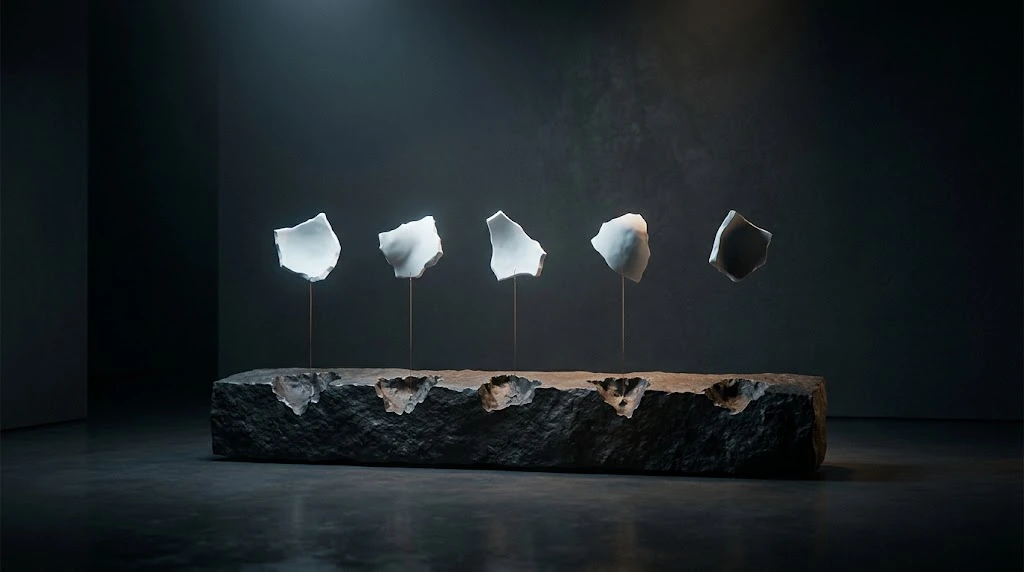
How this image was made
Original illustration made with Google Gemini · 1024 × 572
Generate an image: Create an original museum-grade computational sculpture photographed as a physically present installation, horizontal 16:9. Deep anthracite void, mineral porcelain whites, restrained ice-blue and amber accents, fine particles only where structurally meaningful, tactile surfaces, subtle volumetric illumination, believable depth, exceptional edge detail and intentional negative space. Several crisp porcelain fragments hover in a dark chamber, each tethered by one fine copper filament to its matching mineral imprint on a solid base. One fragment has no tether and remains separated in shadow. Orthographic editorial composition with physical depth. Keep the image sophisticated and legible at mobile size: one dominant mechanism, a clear silhouette, no decorative overload. No text, letters, numbers, typography, captions, symbols, watermark, logo, fake chart, screenshot, interface, identifiable people or artist signature. Do not imitate any specific existing artwork.