Silent Regression: Your AI Prompts Are Breaking Without You Noticing
Keep a family tree of your prompts: see which change broke what with GEPA Visible Lineage — and why this article's outline wrote itself
Silent Regression: Your AI Prompts Are Breaking Without You Noticing
Mustafa Saraç | NeuraByte Labs July 3, 2026
Summary
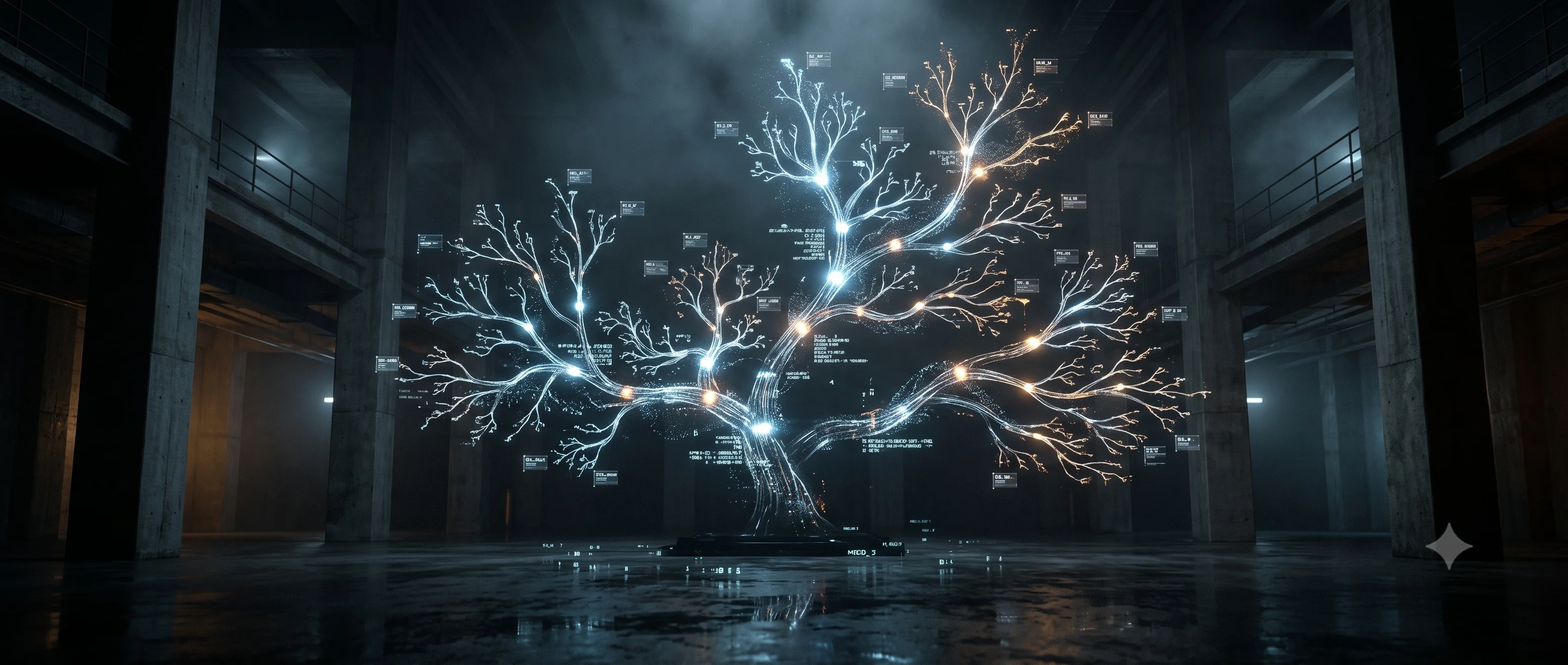
This article's outline was produced by the very tool it describes. GEPA Visible Lineage, a feature I added to the RUNE framework, exports how a prompt evolves across generations — which variant won and why, where the score jumped, which change broke what — as a visible family tree.
The shortest definition: git blame, but for your prompts. For any line of code you can say "who changed this, when, and why." Can you say the same about your prompts?
At the end of this article you'll find two things: this article's own evolution records (with real scores), and a copy-paste starter prompt that lets your own AI assistant adapt the concept to your system.
The Silent Regression Problem
There's a common assumption: "Prompts are text; versioning them in Git is enough."
Not wrong — incomplete. Git tracks character changes, not semantic drift. Why you changed a prompt, which failure triggered that change, which neglected scenario (edge case) the change silently broke three weeks later — none of that fits in a commit message.
Everyone running LLMs in production has lived this scenario:
- Prompt v1 works. Nobody touches it.
- A new requirement arrives — "it should also do this." Prompt v2.
- v2 handles the new job but breaks an old case v1 used to solve. Nobody notices.
- Three months later, a customer complaint. You check the logs. The prompt has 5 versions, and not one of them records why it changed.
I call this silent regression: part of your system starts to rot while every light on the dashboard stays green. For code, we built CI/CD, test coverage, and a blame culture. For prompts, most teams are still in 2023: a text box, a gut feeling, and a "this feels better."

What Is GEPA?
GEPA (Genetic-Pareto) is a prompt optimization method popularized by the 2025 paper "Reflective Prompt Evolution Can Outperform Reinforcement Learning." Don't let the name intimidate you — the idea comes apart in three pieces:
- Genetic: Variants of the prompt are generated — each one a "mutation." Think of them as slightly differently worded siblings of the same prompt.
- Pareto: Survivors aren't picked by a single score but by dominance across multiple criteria. Not "the fastest," but the one that's accurate and safe and readable.
- Reflective: Here's the real trick. The classic alternative is RL — Reinforcement Learning: the system makes thousands of blind attempts, keeps going wherever the reward score rises, and can never tell you why it improved. In GEPA, the LLM looks at its own output in language: "This answer was weak here, because..." That reflection steers the next mutation.
The result: every generation learns from the previous one, and — the critical point — every step of the learning process is human-readable. With RL you're left with a rising score curve; with GEPA, the rationale for every mutation is plain text.
Comparing the Three Approaches
| Manual Iteration | RL / Black-box Tuning | GEPA Reflective Evolution | |
|---|---|---|---|
| Mechanism | Trial and error, intuition | Reward function, blind optimization | The LLM evaluates its own output and evolves with rationale |
| Cost per attempt | Cheap but eats human time | Very high (thousands of rollouts) | Low (big jumps from few attempts) |
| Regression visibility | None — "it worked yesterday" | Low — the score drops, the cause stays dark | High — which mutation broke what, on record |
| Traceability | Git commits (meaningless) | Nearly none | Full family tree: parent, score, strategy, feedback |
| In one sentence | "I think this one's better" | "The score went up, don't ask why" | "This change worked for this reason — here's the record" |
Visible Lineage: Making Evolution Observable
GEPA itself is an optimization method. The piece I added to RUNE is the visibility layer: exporting the family tree (lineage) of every prompt evolution and viewing it with a single HTML file.
Every node in the tree is essentially a record like this:
{
  "id": "v2.4",
  "parent": "v2.3",
  "score": { "before": 0.76, "after": 0.88 },
  "mutation_reason": "15% of users misread the return window — added explicit emphasis",
  "feedback": "Model no longer guesses in ambiguous cases"
}
These four fields change everything:
- parent — which variant this one descends from (like a parent commit in Git)
- score — where quality moved from and to
- mutation_reason — the rationale for the change, in plain language
- feedback — the lesson carried into the next generation
A prompt is no longer a static text file; it's a data structure that carries its genetic memory. You're not recording the change — you're recording the thinking behind the change.
Where It's Useful: Real Scenarios
Tech demos are easy; an honest usage map is hard. I've ended each scenario with a note on what it looks like in your system:
1. Teaching: Showing prompt optimization
Instead of explaining prompt improvement to your team or a workshop audience, you project the family tree: "How did the rough prompt at generation 0 carry the score from 0.58 to 0.88 by generation 3?" Participants see prompt engineering not as an art but as an observable evolutionary process.
In your system: Instead of writing a "how to write good prompts" document for your team, show the 3-generation evolution of one real prompt. Ten minutes in a meeting is enough.
2. Agent governance: The instruction evolution of autonomous agents
If you run multiple autonomous agents (my setup has three agents on three machines), each one's scheduled tasks start with vague instructions: "check the agents." Lineage records, step by step, how that instruction evolves into a role-based, guarded (guardrailed) operating loop. If a change makes an agent go off the rails, you see which mutation is guilty and roll back to the stable version — like git revert, but for behavior.
In your system: If you have even one AI task running on cron or a schedule (daily digest, weekly report), its prompt is drifting over time. Write one line of rationale for every change — that's the first node of your family tree.
3. Audit trail: "This prompt is not arbitrary"
An audit trail is the formal name for the "who changed what, when, and why" record — the way banks log every money movement. Anyone running customer-facing AI (sales, support, recommendations) will eventually hear the question: "Why did the system say that?" With lineage, the answer is deterministic: "The sentence added three iterations ago broke the context — here's the proof, here's the rollback." In compliance conversations, it's the shift from "we trust it" to "we can show it."
In your system: If you have a single customer-facing LLM feature, can you answer "what was the prompt that day, and why was it that way?" within 5 minutes of tomorrow's complaint? If not, this scenario is yours.
4. Regression tracking across model migrations
When you switch models (GPT to Claude, or Gemini's next version), which of your old prompts broke? Lineage plus scoring turns model migration into a CI step: cases the old generation solved but the new environment breaks become visible immediately.
In your system: Before your next model upgrade, run your critical prompts on the new model and compare scores. The diff table = the evidence behind your migration decision.
Where it's not useful — the honest part
- One-shot prompts. Keeping a family tree for a prompt you'll use once and throw away is cost, not benefit.
- Quality you can't measure. Lineage is only as valuable as your scoring is meaningful. If score production isn't automatic and reliable, the tree is just a fancy diary.
- The "let's optimize everything" reflex. Visible evolution pays off for prompts that are reused and measurable. The rest is theater.
Questions to Ask Yourself
When evaluating this tool — or any prompt management tool:
- Can you prove what your most critical production prompt looked like three versions ago, and exactly why you made that change? If the answer is no, you have silent regression risk.
- If your AI agent starts spouting nonsense tomorrow, how many hours will it take you to determine whether the problem is the model or your prompt's drift over time?
- Where do your scores come from? By hand, via LLM-judge (one model grading another model's output), or from real user metrics? Lineage without scores is a map without a compass.
- Who will fill this tree? If recording is manual, it won't happen. If it doesn't hook into your normal workflow automatically, it's shelfware.
- Who will look at it? Visualization only produces value if it's checked regularly. Does it have a slot in your weekly routine?
Questions three and four are the breaking points. If you can't answer "yes" to them, build measurement and automation first — add visualization later.
Meta-Closing: This Article's Own Family Tree
The part I promised. This article's outline was produced with RUNE's swarm command — that is, with the very evolution loop it describes. Real numbers, no gloss:
GENERATION 1 — outline production
$ wand swarm "Plan a comprehensive blog post for mustafasarac.com: ..." --agents 3 --rounds 2

Devil's Advocate  73.4  |  Expert  73.0  |  Creative  72.4
Fusion (top 2)                 → 74.4  (+1.4)

GENERATION 2 — revision from reader feedback
$ wand swarm "Improve the revision request: jargon explanations,
  real scenarios, copy-paste CTA..." --agents 3 --rounds 1

Expert  75.2  |  Devil's Advocate  73.9  |  Creative  71.0
Fusion (top 2)                 → 77.6  (+3.2)
Two generations, two fusions, 74.4 → 77.6 overall. Not a revolution — and saying so is exactly the point of this article. The marketing version would say "scores up 40%!" The honest version: a modest, measured improvement with its reasons on record.
The who-contributed-what record survives too: Devil's Advocate's "silent regression" framing became the article's backbone. In generation two, Expert's mutation — "developers don't read, they scan; translate jargon into their language" — produced the parenthetical explanations you've been reading. I know who contributed what — because it's recorded.
An ironic footnote: the swarm's first outline confidently invented the GEPA acronym as "Generate-Evaluate-Propose-Apply." The real one is Genetic-Pareto. The hallucination was caught by human review — and that too is now a node in the family tree: "generation 2, mutation rejected, reason: wrong terminology." The system keeps a record of its own mistakes.
Integrate It Into Your Own System
If you've read this far, you're probably wondering "where do I start?" The fastest route: hand this job to your own AI assistant.
Copy the prompt below, fill in the brackets for your situation, and paste it — along with a link to this article — into whichever AI tool you use (Claude, ChatGPT, Cursor, take your pick):
Act as a senior AI systems architect. I'm giving you the article
"Silent Regression" (GEPA Visible Lineage); the concept: recording prompt
changes with parent → child relationships, score movement, and rationale.

My situation:
- Tech stack: [e.g. Node.js + PostgreSQL, or Python + SQLite]
- My LLM usage: [e.g. customer support bot / RAG pipeline / cron report agent]
- What hurts the most: [e.g. old behaviors breaking whenever a prompt changes]

Your task is to adapt the Visible Lineage concept from the article to my system:
1. Inventory my existing prompts: which ones are reused and measurable?
   (Only those deserve lineage.)
2. Propose a minimal schema for family-tree records that fits my stack
   (id, parent, score, mutation_reason, feedback).
3. Tell me how to automate scoring — LLM-judge, user metrics, or a test
   set? Choose based on my situation.
4. Give me the smallest first step that fits into my workflow with zero
   extra discipline: the version I can set up in 30 minutes today.

Don't lecture on theory; be concrete using the stack and problem I gave you.
The beauty of this prompt: your assistant guides you by looking at your work. My scenarios fit my system; yours will come out different — and they should.
Want to go deeper? GEPA Visible Lineage is part of the RUNE framework. The demos live in the repo — zero install, a single HTML file: demo/gepa-lineage/ and demo/agent-cron-lineage/.
Closing
It took us 50 years to learn version control for code. We don't have 50 years to reach the same maturity for prompts — the systems are already in production, and they're already drifting silently.
Don't trust the words; trust the evolutionary history of the words. Stop writing prompts in the dark.
Bu yazının Türkçesi: Sessiz Regresyon: Prompt'larınız Sizden Habersiz Bozuluyor
Keep a family tree of your prompts: see which change broke what with GEPA Visible Lineage — and why this article's outline wrote itself