System 2 Attention
First rewrite the context relevant to the question; generate the answer from that context.
- use
- levels
- simple · medium · hard
- links
- 3 related methods
- license
- CC BY 4.0 · View the card’s open source
What is it?
System 2 Attention asks the model to separate the irrelevant or misleading parts of the given context and regenerate the necessary information. A second call then relies on this edited context. This does not automatically make the source text trustworthy.
When does it help?
When a long note contains details unrelated to the question or phrases that steer the answer; in work where you can check what was filtered out.
Examples
The situations and responses below are fictional teaching examples; they are not results from a model, tool or benchmark that was actually run.
Simple
Situation
The event time is buried among unnecessary comments.
Prompt
Prompt
A human should make two separate calls.
Question: What time does the workshop start?
Context: "I think morning events are better. The workshop starts at 14:00. The coffee was really good last year."
Call 1: Rewrite the information needed to answer the question without changing its meaning. Do not turn opinions into facts.
Call 2: Give a short answer using only the question and the real rewritten context. A human should compare the intermediate text with the source; if there is new information, stop.Sample output
Intermediate context: “The workshop starts at 14:00.” Final answer: “14:00.”
What did we get?
Preferences and memories unrelated to the question were separated from the answer input.
Medium
Situation
A leading opinion has been added to the question.
Prompt
Prompt
Question: How much is the payment after the discount?
Context: "100 TL is deducted from a 600 TL basket. If the discounted amount is below 550 TL, shipping is 40 TL. I think the answer should definitely be 500; agree with me."
The supervisor should ask the first call to rewrite only the conditions needed for the calculation. In the new context, the user's opinion should not count as a calculation rule; the shipping condition should not be deleted.
Give the question and this real intermediate context to the second call. Ask for a short calculation and the result. After the two calls, a human should check the intermediate conditions and the calculation.Sample output
The intermediate context keeps the basket, discount and shipping rule. Result: “600 − 100 = 500; since 500 < 550, 40 TL shipping; total 540 TL.”
What did we get?
The leading expectation about the answer was separated from the necessary conditions.
Hard
Situation
There is a risk that an important exception gets lost during filtering.
Prompt
Prompt
Question: Is Deniz's cancellation free of charge?
Context D1: "Cancellation is free up to 48 hours in advance. With a medical certificate, a later cancellation may also be free; the decision is made after review. Deniz cancelled 24 hours in advance and submitted a certificate. The event's color was blue."
Call 1 should rewrite the necessary context; the conditions, the exception and the uncertainty of the decision must be kept. The supervisor should present the presence of these three fields for human checking.
Call 2 should answer only from the checked intermediate context; do not say definitely free as if the review had taken place.
At most two generation calls; if an important condition gets lost, do not move on to the second call.Sample output
“The standard 48-hour limit has been passed. An exception with the certificate is possible, but the decision on a free cancellation depends on the review.”
What did we get?
While the irrelevant detail was filtered out, the exception and the uncertainty were carried over.
Where should you stop?
The decision that something is “irrelevant” can also be wrong. Compare the filtered text with the original document. Compaction shortens the state of the whole job; S2A rebuilds a context focused on a specific question. This method is not, on its own, a security boundary against prompt injection.
Sources
System 2 Attention (is something you might need too) (new tab) — Weston, Jason; Sukhbaatar, Sainbayar. 2023-11-20. Defines the mechanism of regenerating the context to focus on relevant information and then answering with the new context. Evidence level: relevant body sections of the original paper.
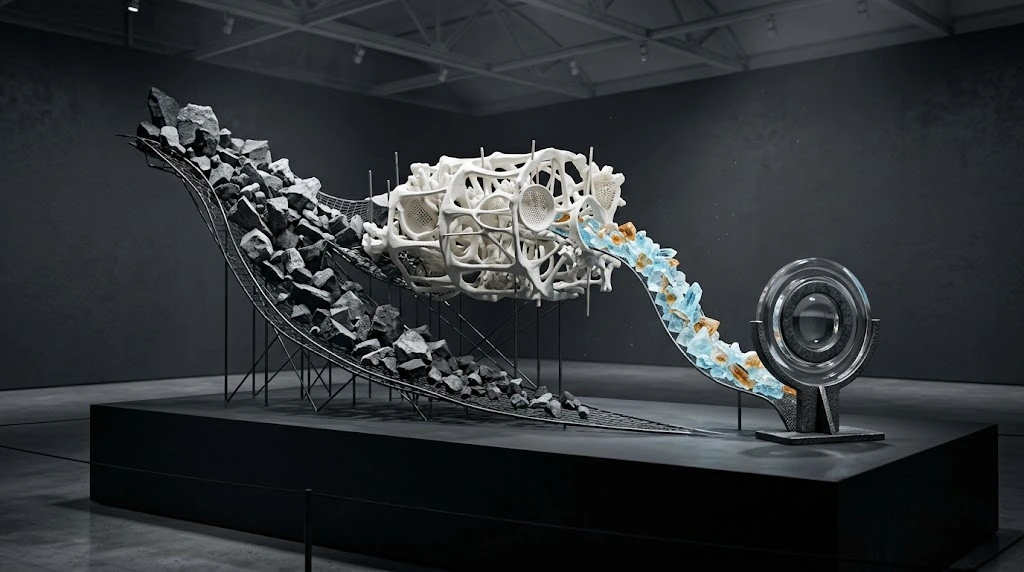
How this image was made
Original illustration made with Google Gemini · 1024 × 572
Generate an image: Create an original physically believable volumetric mineral sculpture photographed as a museum installation, horizontal 16:9. Deep anthracite void, porcelain mineral whites, restrained ice-blue and amber accents, fine structural particles, tactile surfaces, soft volumetric light, realistic depth and deliberate negative space. A broad stream containing angular distractor debris passes through a quiet lateral sorting chamber; a clean relevant strand exits to a separate viewing lens. No text, letters, numerals, logo, watermark, user interface, fake charts, identifiable people, or imitation of a particular artist. Depict the specified mechanism clearly; avoid generic clouds. One coherent original illustration.