Projects, guides and writing on AI coding workflows and developer tools, most of them built with AI coding agents such as Claude Code and Codex. Every entry passes a script check and a manual review before it is listed. My profile is on GitHub (opens in a new tab).
Start here
Featured
Alpha2026
Agentic Loop Atlas
Registry · AI coding agents
A registry of reusable operating loops for AI coding agents such as Claude Code, Codex, Cursor and Hermes. Each loop names its trigger, its proof and its stopping condition, and CI validates every entry against a schema.
A static guide to operating Hermes Agent from the terminal: setup, memory and skills, the messaging gateway and scheduled jobs. Commands were checked against Hermes Agent v0.21.5. Unofficial; not affiliated with Nous Research.
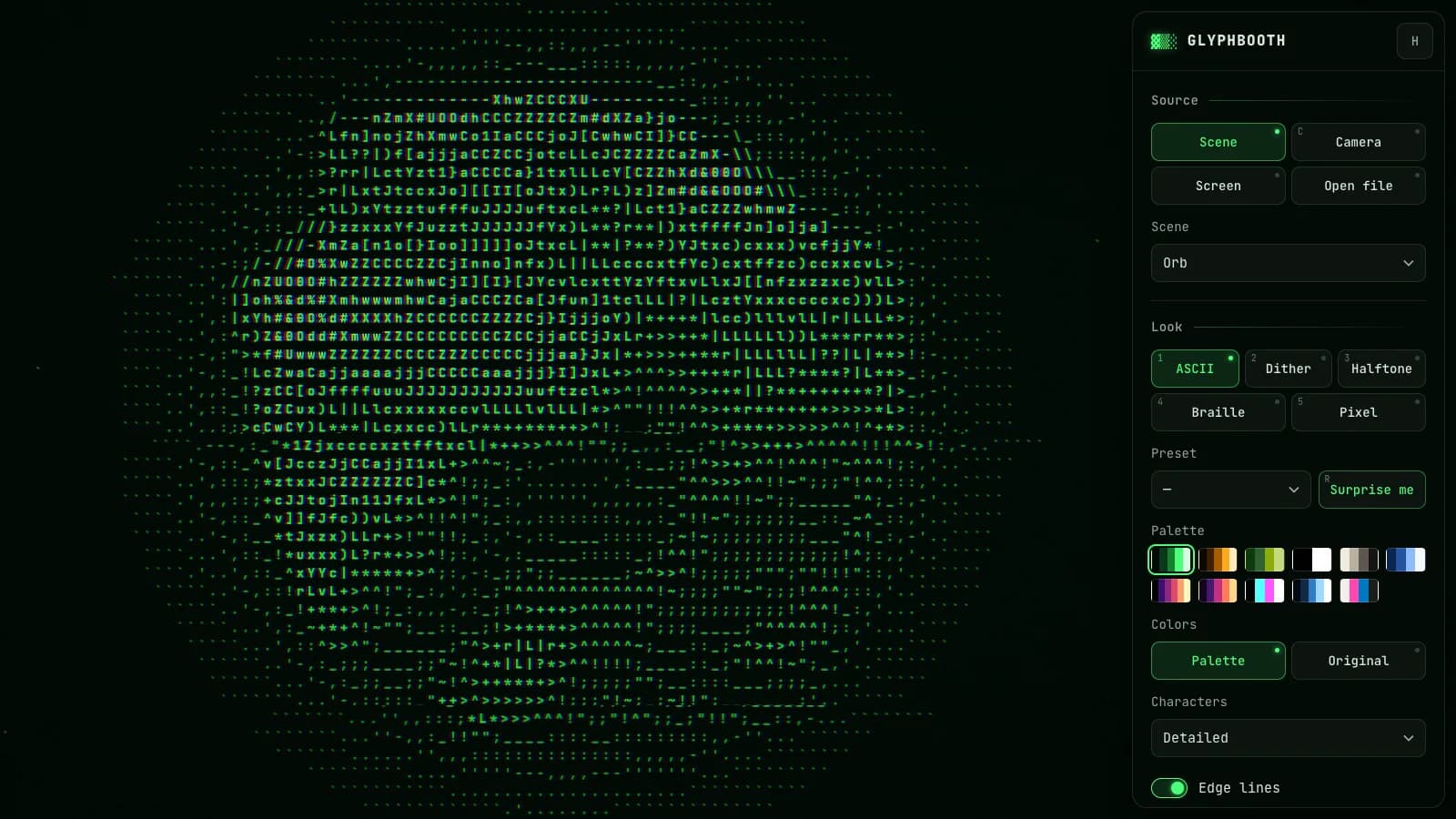
Turns a camera, a screen, a video or a song into live ASCII, dither, halftone, braille or pixel art. Runs in the browser, with desktop builds for macOS, Windows and Linux.
Built in one night by one person directing five AI coding agents, with a review step and CI.
Restructures a prompt into 8 layers and ships a blind A/B harness that compares it with the raw prompt. In my own pilot (50 pairs, 2 Gemini models) the amplified prompts were preferred in 19.6% of decided pairs, so they lost.
Live agent map · TypeScript, three.js, Bun, Python
60 seconds on demo data: the waiting agent, the agenda tower, the daily task road and a failed scheduled job.
A live map of the AI coding agents running on one Mac. When an agent stops to ask a question or to ask for permission, its unit turns red, an alarm line runs to the operator and a counter shows how long it has waited.
Status: prototype, closed source. The rendering engine is Giacomo Magnanini's pdoom-video (MIT), via Luis Bizarro's evangelion adaptation (MIT); CITADEL adds the map, the live data path and the alarms.
237 commits, 29 Sep to 4 Oct 2026
835 tests in 74 test files (TypeScript and Python), all passing on 6 Oct 2026
52 lines changed in the reused engine; the world, probe, collector and alarms are new
Demo video runs on fixture data only: no real sessions, agenda or mail
A deterministic, model-free simulator of a finite authority model for AI agents: agents get narrow, scoped authority and return evidence, and a separate trusted layer decides what becomes canonical state.
A simulator proof, not a production agent runtime. The full property proof is not established yet, and the README lists what is still missing.
A registry of reusable operating loops for AI coding agents such as Claude Code, Codex, Cursor and Hermes. Each loop names its trigger, its proof and its stopping condition, and CI validates every entry against a schema.
A live map of the AI coding agents running on one Mac. When an agent stops to ask a question or to ask for permission, its unit turns red, an alarm line runs to the operator and a counter shows how long it has waited.
Answers questions about your own documents with citations back to the source, using NotebookLM through the unofficial notebooklm-py library. It needs a logged-in Google account.
Turns a camera, a screen, a video or a song into live ASCII, dither, halftone, braille or pixel art. Runs in the browser, with desktop builds for macOS, Windows and Linux.
A static guide to operating Hermes Agent from the terminal: setup, memory and skills, the messaging gateway and scheduled jobs. Commands were checked against Hermes Agent v0.21.5. Unofficial; not affiliated with Nous Research.
A browser instrument with four bounded physics and biology scenes (PELAGIC, STRATA, ORBIT, CHORUS) drawn on one Canvas 2D surface. Pointer and touch input perturb each scene, and the system settles when released.
Release 1 only. Static site with no backend, accounts or analytics.
A prompt machine with no language model inside. It turns a number into a build dare for a frontier model, and keeps an honest wall of the runs.
Every sentence traces back to a gene and an atlas entry, and the same number always gives the same prompt. The wall holds one card so far: the machine's own build.
Restructures a prompt into 8 layers and ships a blind A/B harness that compares it with the raw prompt. In my own pilot (50 pairs, 2 Gemini models) the amplified prompts were preferred in 19.6% of decided pairs, so they lost.
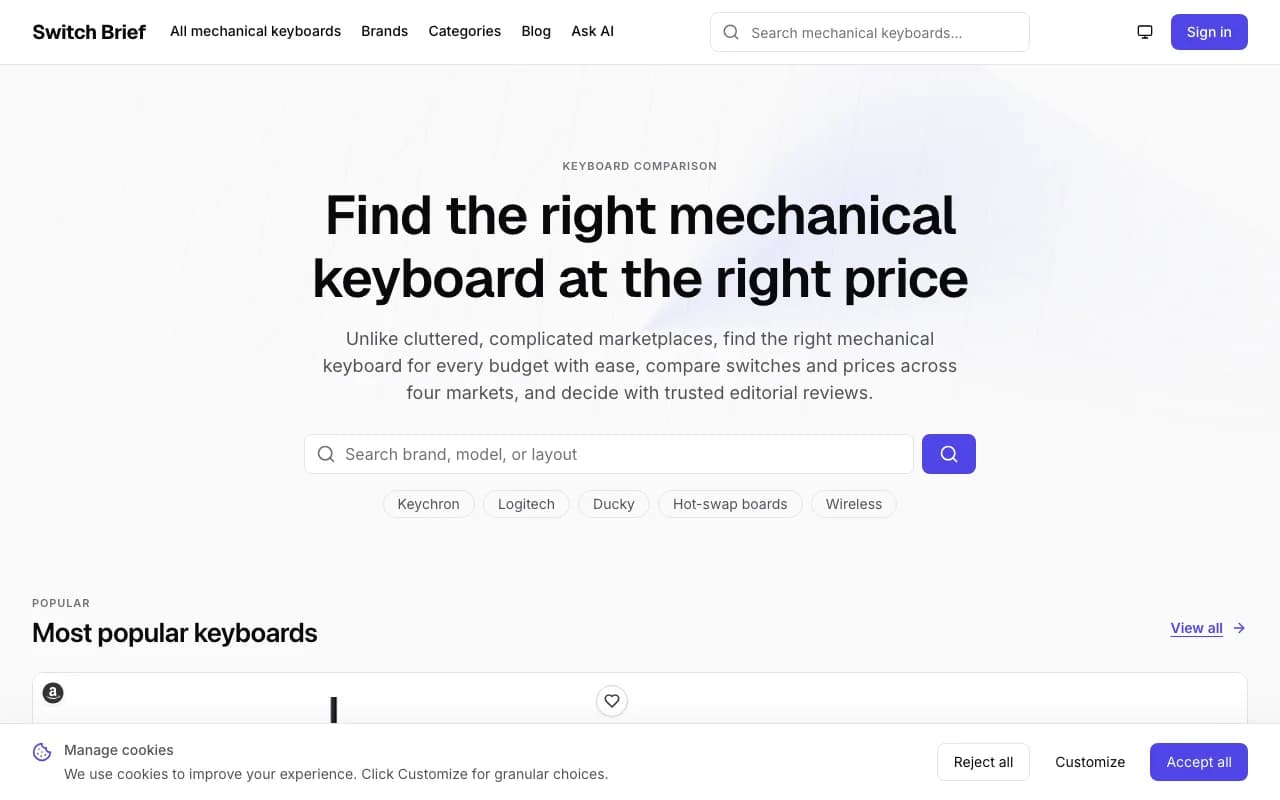
A mechanical keyboard comparison and buying-guide site that earns Amazon affiliate commission. I run the product catalog, write the articles and keep an evidence ledger for every claim; the storefront runs on a managed platform (UseBravery).
Repository is private. The product is keyboard research, not AI work.
Live since July 2026; 69 public products (read-back 22–23 Sep 2026)
First buying guide published 28 Sep 2026
$1.73 commission from one order, 23 Aug–21 Sep 2026, per the Amazon Associates report recorded in the project log; payout not verified
A read-only macOS script that reports the USB-C speed and power signals macOS has negotiated for the current cable, port and device. It does not certify or benchmark cables.
Unofficial Rust bindings for the Cactus on-device inference engine: chat, streaming, embeddings and speech-to-text. Distributed from GitHub, not crates.io.
Upstream later added its own Rust bindings: a raw FFI crate in February 2026 (#382) and bindings/rust in May 2026 (#653).
The gate
How entries are chosen
An entry is listed only when it passes all of these:
It is my own repository, not a fork, with a README and a licence.
The status matches the repository. If its CI is failing, the entry is a Prototype at most. Archived means archived on GitHub.
Every link loads without an error, stays on the same site and is not a bot-check page. Package and repository links are also confirmed through the GitHub, PyPI or crates.io API.
No hype words.
A number on a card must be one you can check in the repository.
Screenshots and case studies are checked by hand for personal data.
A script checks rules 1 to 4 and the GitHub star counts on every change to this site and again after every deploy. I check the other numbers and the screenshots by hand.
Released
Usable today: a release, a tag or a working live version.
Alpha
Works, with known gaps that the README lists.
Prototype
An experiment or proof of concept. Maintenance is not promised.
Case study
Closed source. Shown with writing, screenshots or video.