Looking at AI Through the Rearview Mirror
Why do people still judge today's agents by their first ChatGPT experiences?
When I suggest people use AI agents, I often hear the same three objections: “It hallucinates.” “It writes buggy code.” “How can I delegate work to something that makes this many mistakes?”
I see the same pattern on X. Someone shares a snippet of ChatGPT writing wrong code, another points out a hallucinated source, and it leads to the blanket conclusion that AI is useless.
The objections aren't made up. Models have written wrong code, hallucinated sources, and talked nonsense with absolute confidence. They still do.
What’s missing isn’t accuracy, but history. People are measuring today’s agent systems by the behavior of the first chat box they ever encountered.
What year is the AI in your mind from?
In my notes from Hal Elrod’s The Miracle Morning, I highlighted an idea called “Rearview Mirror Syndrome”: the tendency to mistake our past limitations for the measure of our current potential.
This is exactly what we are doing with AI. We are taking an error made by a chat box in 2023 and treating it as the hard limit of what an agent system can do in 2026.
When the first point of contact is a chat box, the limits of that box unintentionally become the limits of the entire category. Most of the time, what people are objecting to isn't agent systems, but that box they remember.

The problem isn’t skepticism; skepticism is healthy. Someone who had a bad first experience was acting rationally at the time: the models were genuinely worse, and not delegating work to them was the right decision. The issue isn’t the decision itself, but the fact that it doesn't have an expiration date.
Because what I use today is not a language model standing alone.
I watch the process, not just the answer
I experience this shift through Hermes. Agents I named RICK, MORTY, and SUMMER perform different tasks within the same system: one plans, one executes, one researches and reports. Each has its own memory, tools it can use, task boundaries, and points where it must get approval from me.
When asking a chatbot a question, I was evaluating a single answer. When working with an agent, I am evaluating a process: Did it actually read the file? Did it run the test? Did it stop at the risky part?
Hallucination doesn't magically disappear here. But it no longer has to be the final word. An agent might produce something wrong; then it can read the file, run the test, check another source, or have its output verified by another agent. I can bound the model's weakness with the rest of the system.
The second difference is even bigger: the system changes over time. I’m not saying the model secretly trains its own weights overnight; the self-improvement I see happens at the system level. When I fix an error, the lesson can be distilled into memory, a skill, or a working rule. When a similar task comes up again, we don’t start from scratch.
Even when I replace the underlying base model with a more powerful one, the agent doesn't lose its identity. The same role, the same memory, and the same tools start working with a better reasoning engine. The model isn't the only thing evolving; the entire workflow is.

The engine running underneath is also changing
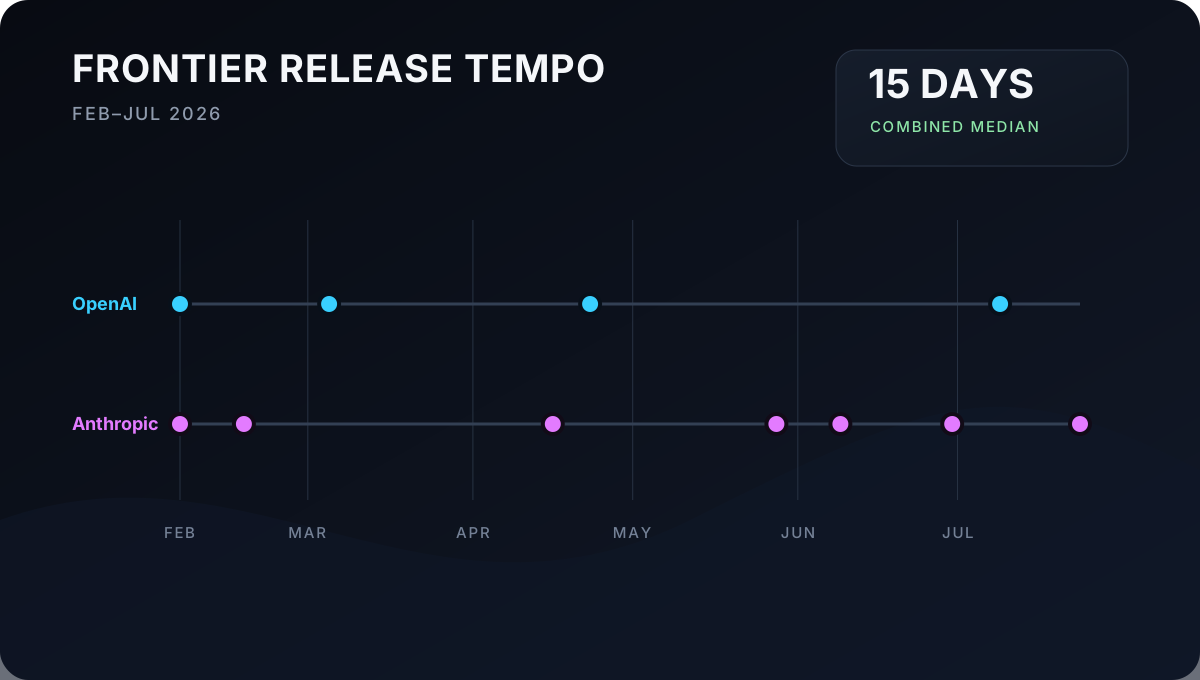
While this structure develops, the model I plug into it is also changing rapidly. When I line up the official announcements from OpenAI and Anthropic, the median interval in the combined stream between February and July 2026 is 15 days.
This doesn't mean every company releases a major model every two weeks: in the same period, the median for selected frontier series was 49 days at OpenAI and 22.5 days at Anthropic. The schedule is irregular. But from the user's perspective, the accessible set of frontier options refreshes roughly every two weeks.
Self-improvement is no longer just a theory, either. In an official announcement, OpenAI describes its frontier coding model as “the first model to play an instrumental role in its own creation”; early versions were used to debug its own training, manage its deployment, and diagnose test results. This is the company's own statement, not an independent measurement. But even the statement itself shows where the threshold has moved.
We have moved into a state of pure singularity. In short:
Singularity is where AI accelerates its own development, and this speed surpasses the limits of human tracking.
If an agent can develop another agent, and that one develops something even better than itself, progress moves beyond our own pace.
The singularity has begun.
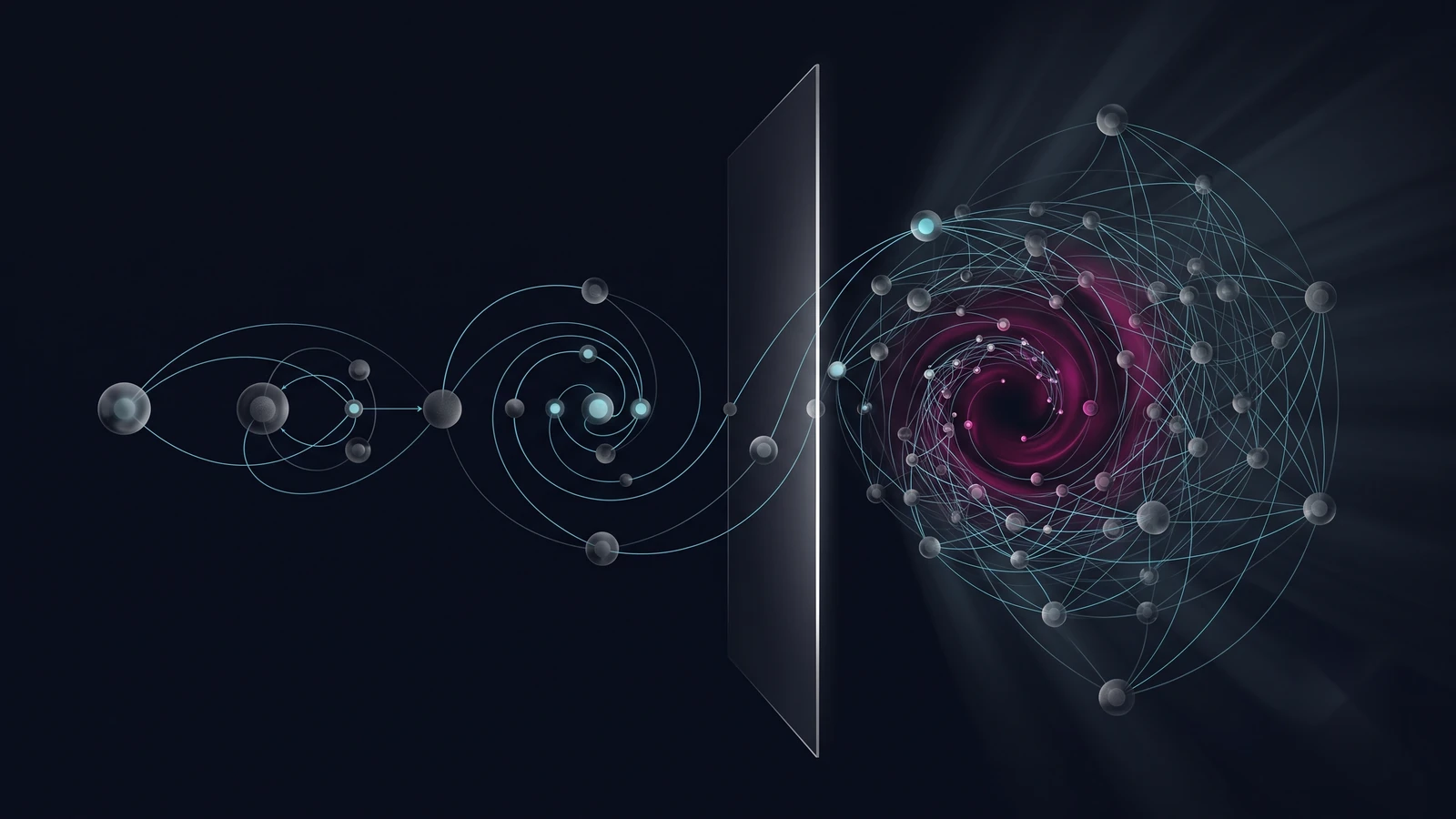
Measuring today’s agent by your first ChatGPT experience is, therefore, like changing lanes while looking in the rearview mirror. The road in the mirror was really there. It’s just no longer where you are.
How much does conviction change with new evidence?
How a conviction is carried from one task to another is something that can be measured.
In a study by Biswas, Erlei, and Gadiraju published at CHI 2026, 240 participants performed a total of 7,200 human-AI interactions across three different tasks. Participants carried the conviction formed in the previous task with them as they moved to the next: a 10-point increase in prior belief predicted a roughly 3–4 point increase at the start of an unrelated subsequent task.
Participants didn't reject new evidence; they updated in the right direction, but at about half the speed of the Bayesian benchmark. Decisions to delegate work to AI were also more related to the participants' own beliefs about accuracy than the actual performance of the system.
This study doesn't measure the transition from old chat boxes to today's agents; it measures the transfer of belief between different tasks. Still, the mechanism is familiar: new evidence is not written on a blank page, but over the first conviction.
In the anchoring study by Nourani et al., seeing a system perform strongly or weakly the first time affected subsequent trust evaluations; adding explanations did not completely erase the effect of the first impression.
Trying the same job again
I’m not telling anyone to “trust agents, they don’t make mistakes anymore.” Quite the opposite: I tie trust not to the model’s elegant sentence, but to the system’s method of verification.
The sentence “AI writes wrong code” no longer means anything on its own. Which system? With which tools? When?
There’s no need to remove the rearview mirror; the errors there were real. Just don’t mistake the road you see in the mirror for the road ahead of you.
The cheapest way to update an old conviction isn’t to argue, but to try again. Find that real job it couldn't handle during your first bad experience; keep the same input and the same success criteria, and give it to a modern agent system. Then, don’t just look at the answer, but at these:
- Did it just give an answer, or did it verify the work?
- Was it able to catch its mistake through a test or a source?
- Did it carry a permanent lesson to the next attempt?
- Did the same system work better when a more powerful base model arrived?
The result might still be bad. Let it be—at least your judgment will be grounded in today's reality.
Resources
- Biswas, Erlei & Gadiraju, Belief Updating and Delegation in Multi-Task Human–AI Interaction, CHI 2026.
- Nourani et al., Anchoring Bias Affects Mental Model Formation and User Reliance in Explainable AI Systems, IUI 2021.
- OpenAI official frontier announcements: February 5, March 5, April 23, July 9.
- Anthropic official frontier announcements: February 5, February 17, April 16, May 28, June 9, June 30, July 24.
Why do people still judge today's agents by their first ChatGPT experiences?