Take the Pomodoro Technique one step further | Focus on breaks!
How to spend 5-minute breaks productively
Take the Pomodoro Technique one step further | Focus on breaks!
How to spend 5-minute breaks productively
This post is about a different methodology for those who use or are considering using the Pomodoro Technique.
Since I learned about the Pomodoro Technique, I have been trying to use it actively every day. I know that whenever I use this method, I find myself more productive and see better results.
What is the Pomodoro Technique? Briefly: it is a time-management technique where we focus on a task using 25+5 minute intervals.
In fact, I wrote a post about this a few years ago.
For me, these 25-minute work periods were always effective, but I didn't know what to do during those 5-minute breaks. Over time, I began to feel these breaks were unnecessary. Eventually, I started turning my work into blocks (25 min. + 25 min.). However, research articles I read suggested that our maximum focus duration isn't as long as I had imagined.
- https://journals.physiology.org/doi/pdf/10.1152/advan.00109.2016
- https://tr.wikipedia.org/wiki/Dikkat_süresi
In other words, I was pushing my limits. Studies actually showed that focus increases when you take short breaks. With this data in hand, skipping those 5-minute intervals started to feel illogical. Yet, I still lacked a model or motivation to actually get up from my desk.
When the need for a break arose, I started thinking that the real life-changing shift might not happen during the Pomodoro session itself, but during the break. So, what could I do for 5 minutes that would actually make me get up? Getting up every 25 minutes just to make coffee, drink water, or go to the bathroom soon felt like empty routines overshadowed by the work tempo. Could there be something better? Could I spend this time more meaningfully?
I thought about these five minutes for a while and decided to try different things to make the time count.
Dividing 5 minutes into 5
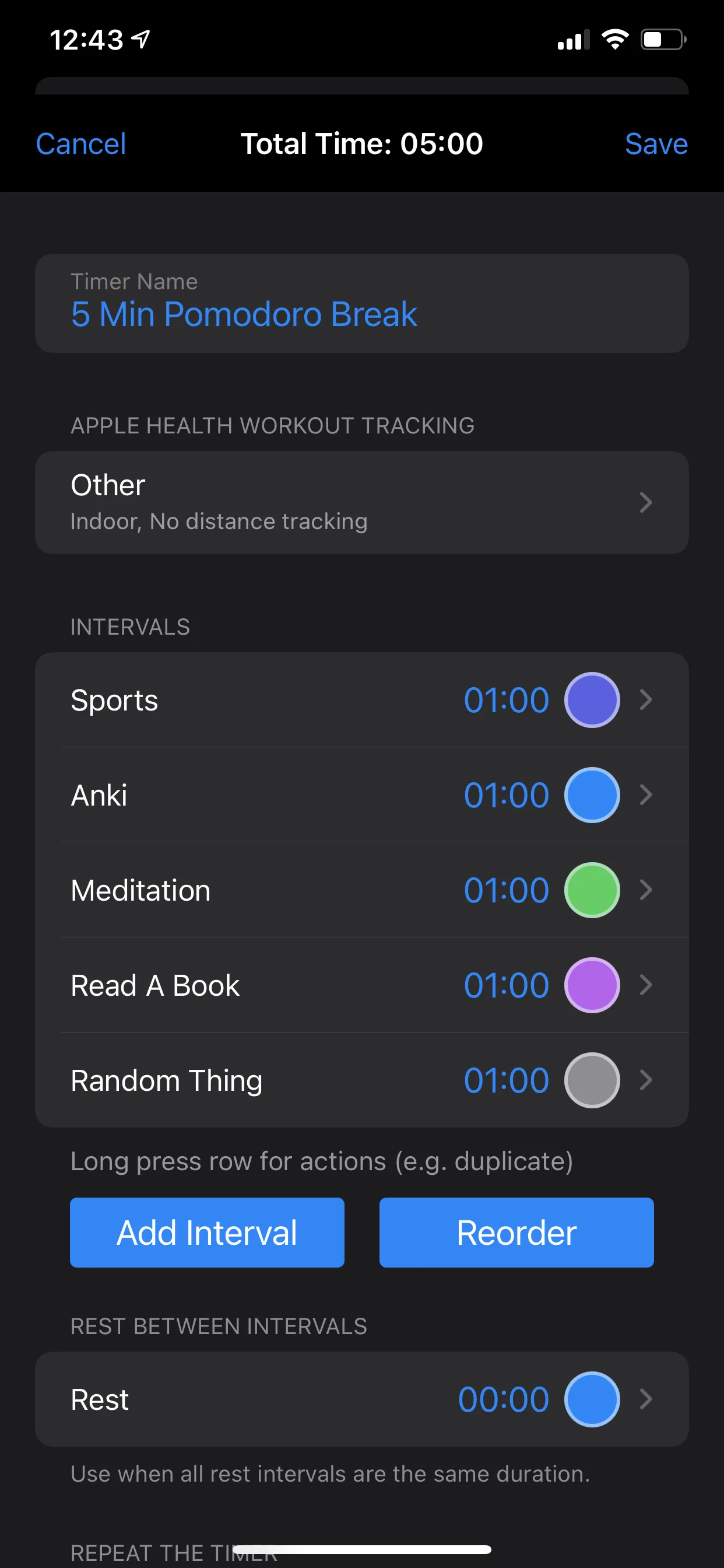
First, I divided these 5 minutes into five separate, one-minute intervals—short, manageable, and simple. I decided to define one useful task for each minute. For this, I needed a list. What could I do in just one minute? Something simple, valuable, and easy enough that I wouldn't procrastinate.
I made a short list of small but valuable changes. What could I do in those 1-minute slots?
I could do push-ups; more than 10 push-ups fit easily into this time. I already wanted to do at least 10 a day anyway. Perfect. I could do sit-ups; I last did them a year ago at the gym, and until now, I lacked the motivation to get back on the floor. If I'm at home, sure; at work, maybe not. Perfect. I could do a plank; that thing gets you shaking after 20 seconds. I could do squats for a minute, or even just for 10-20 seconds. Perfect. I was aiming to study Anki for at least 25 minutes every day; I figured I could do a minute of Anki too. Opening and closing the app takes 10-20 seconds. I'd pick a random deck (Anki has study decks, I'll explain this later). Perfect. I could meditate; I could never quite get that habit to stick. One minute is a great starting point—daily meditation, super. Perfect. I could do absolutely nothing. Hmm, a very good idea. What does "doing nothing" look like? I could step out onto the balcony and just watch the sky, the birds, or the clouds. Perfect. I could do things I usually procrastinate on (not that I ever do that, haha). I could organize my desk in a minute, or even wipe it down. I could go to the kitchen and wash a few dishes. If there were more, I'd come back in the next break. Perfect.
I could do these things in random order during every 5-minute break. This way, I'd be accomplishing something, I'd have a reason to get up, and I wouldn't get bored. It gave meaning to a 5-minute break that previously had none. It was worth a try.
What app did I use, and how did I try it?
I've tried many Pomodoro apps, but I couldn't find one that let me divide breaks into segments like this. So, I decided to use Intervals Pro, an app I'd found earlier designed for interval training for athletes. I created 1-minute "activities" within it and used it that way. Honestly, there's a real need for a Pomodoro app like this. Maybe it'll be my next project 😉
What were the benefits, and how did I feel?
Once I started segmenting these 5 minutes, the breaks actually became more fun than the 25-minute tasks themselves. I'd find myself thinking, "I hope I finish this soon so I can do a minute of squats..." The effect was much stronger than I expected. I wondered if it was just a placebo effect—would it work for others too?
I shared this experimental idea with Hilal and Berk, and they were immediately game to try it. Here are the comments they shared about their experience.
Comment 1
The 1-minute activities I found most productive: Watering my plants, breathing exercises, eye exercises, and smelling aromatic oils. For things on my to-do list that usually cause me to dawdle—like organizing my desk or making the bed—I write them on a note while working and tackle them during these one-minute slots.
Benefits: I end up checking off small tasks during my breaks. I manage to accomplish much more in a day because I tell myself, "How hard can a 1-minute task be?" and finish everything through these tiny goals.
Doing exercises that raise my heart rate while I'm learning new information also proved beneficial.
It provided a sense of time awareness; I now know what 25 minutes feels like while working. I might even be able to do 25-minute sessions without checking the clock, but I had no idea how long 5 minutes in a break actually felt. Most breaks where I thought "it's only been 5 minutes" turned out to be 15. Using time while being aware of it is like shopping with cash instead of a credit card.
- Hilal DemircioğluComment 2
I had never used the Pomodoro technique before. I tried it after Mustafa mentioned it, and the impact on my efficiency was incredible.
At first, it seemed a bit complicated, but the results on the first day were amazing. I used this method while waking up at 5:30 AM for meditation and morning pages, and throughout the day for my Java lessons and university work. I divided the 5-minute breaks into 1-minute slots as Mustafa suggested.
I spent the first part of the break exercising—30 seconds of push-ups and 30 seconds of sit-ups. I devoted the next minute to reading; even just reading two words in a book seemed to stick in my mind better. I spent the next minute watching videos on my phone (usually something funny), and the following minute listening to music (I recommend Marconi Union - Weightless). I found I could hear the harmony and the most subtle instruments much more clearly.
I spent the final minute writing about the future. Don't underestimate what you can write in one minute; it flows so naturally that just picking up the pen is enough—your thoughts and brain take over. During the 25-minute work periods, I found I could stay focused without distraction, and these focused sessions became more frequent, allowing me to see details more clearly. For example, in Java class, I would catch the teacher's mistakes while they were still writing the code. I'd find myself telling them where the error was as if they could hear me (usually in an annoyed voice 🙂). Thanks to this technique, my work became more enjoyable, less boring, and much more efficient.
I'd like to thank Mustafa SARAÇ for introducing me to this technique.
- Berk SaraçClosing
I definitely recommend trying this method; I'm curious to see how it affects you. After all, it's just 5 minutes 😀
App Recommendations
Intervals pro https://www.intervalspro.com/
Focus tomato https://apps.apple.com/us/app/focus-tomato-lets-focus-now/id1471458198
A Video about Pomodoro
THE POMODORO TECHNIQUE by Greg Head, Ep 61
How to spend 5-minute breaks productively